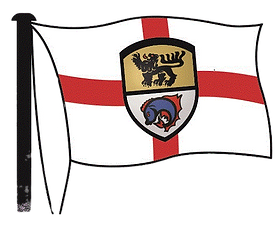


Ship History
White Orchid, originally named Aquila, was constructed by James A. Silver at Rosneath, Scotland, in 1932. The vessel was one of the Dunkirk Little Ships and had a distinguished and eventful career, aging gracefully before being retired with dignity.
In 1935, White Orchid gained prominence by leading the Thames Silver Jubilee procession in honour of King George V and Queen Mary, navigating the Thames from Teddington Lock. After seven years serving as a gentleman's motor yacht, she was commandeered by the Royal Navy and participated in the Dunkirk evacuation, operating off the beaches of La Panne.
Following her return from Dunkirk, the Admiralty compulsorily acquired the vessel and employed her as a torpedo recovery vessel along the South Coast of England until 1949. It is notable that many of the Little Ships were not formally transferred to Admiralty ownership until after their Dunkirk service, due to the urgency of the evacuation. The formal acquisition was later regularised as the vessels’ utility was recognised and naval crews became accustomed to their operation, with the assumption that they might be required again.
After World War II, White Orchid resumed her original function and was renamed Doutelle. She was co-owned by Ben and Norman Cannell and took part in the first return to Dunkirk on the 25th anniversary of Operation Dynamo in 1965. Both Ben Cannell, who became Commodore of the Association of Dunkirk Little Ships (ADLS) in 1975, and his son Norman, who succeeded him, were leading members of the Association from its inception.
In 1967, Doutelle was part of the ADLS Guard of Honour at the Tower of London, welcoming Sir Francis Chichester upon his return from his single-handed circumnavigation of the world. The vessel returned to Dunkirk again in 1975 for the 35th anniversary celebrations. Subsequently, she played an active role in numerous pageants and celebrations held each summer on the River Thames, events that are central to English cultural life.
For twenty-five years, Doutelle was a familiar sight along the banks of the Thames at Fawley Meadows during the Henley Royal Regatta, where the Upper Thames Motor Yacht Club was established. In 1986, extensive dry rot was discovered in her main frame and beams, a condition considered terminal for a wooden vessel. An international marine surveyor and two reputable boat builders declared her irreparable. Consequently, Doutelle was retired and dismantled at Thames Ditton in October 1986, ending her physical existence but preserving her spirit.
A fitting tribute to White Orchid and her fellow Dunkirk Little Ships is the poem To the Seamen by John Masefield, Poet Laureate and war historian at the time of Dunkirk:
You seamen, I have eaten your hard bread
And drunken from your tin, and known your ways;
I understand the qualities I praise
Though lacking all, with only words instead,
I tell you this, that in the future time
When landsmen mention sailors, such, or such,
Someone will say "Those fellows were sublime
Who brought the Armies from the Germans' clutch."
Through the long time the story will be told;
Long centuries of praise on English lips,
Of courage godlike and of hearts of gold
Off Dunkerque beaches in the little ships.
And ships will dip their colours in salute
To you, henceforth, when passing Zuydecoote.